


CFOs often find themselves at the crossroads of driving profitability and enabling innovation. With the rising challenges of modern B2B operations, CFOs need to take an active role in shaping the future. For practical insights into securing board-level buy-in for strategic initiatives, explore "How to Secure Board Approval for Digital Selling". If you're evaluating your marketing efforts, check out our "Essential Guide to Evaluating Your Marketing Effectiveness". Additionally, for crafting a business plan aligned with digital selling, explore "Building a Digital Selling Business Plan for Success".
You'll Discover:
- Why CFOs are pivotal in shaping B2B success.
- The key areas where CFOs can influence marketing and sales outcomes.
- How to align financial strategy with digital selling initiatives.
- The role of CFOs in overcoming operational challenges.
CFOs to advise restructuring sales and marketing to create a sustainable 21st century business model
Executive Summary
In your role as CFO, you're all too familiar with the frequent appeals for marketing budgets. Your pivotal position requires you to dissect these requests with precision, weighing the potential return against the investment. This narrative is designed to equip you with a pragmatic understanding of these persistent budgetary appeals.
It's an open secret that substantiating marketing ROI has been historically elusive. And yet, a trend is emerging where businesses are prepared to offer substantial compensation for veteran marketing leaders who promise to propel company growth. But is experience always synonymous with progress? It appears that the very veterans who are commanding these premium salaries may also be the architects of current inefficiencies.
In this commentary crafted for the financially astute, we delve into the challenges confronting sales and growth, spotlighting the technological tools and B2B marketing strategies that have faltered, resting on the dated practices of relying excessively on direct selling.
The rhetoric around the necessity of an ever-expanding mar-tech stack is familiar – an investment without which, it's claimed, the business will flounder. Yet, the reality reveals a misalignment, with B2B marketers often mistaking their B2B audience for B2C consumers, resulting in a failure to nurture prospects through an informed buying process.
This strategic myopia has precipitated a call for a radical overhaul, moving away from the traditional one-to-one sales approach to a scalable one-to-many strategy. This view is echoed by thought leaders like Brent Adamson of Gartner, who also recognises the obsolescence of traditional B2B sales and marketing models. You can read his article here, Traditional B2B Sales & Marketing are Becoming Obsolete.
Contrary to the push for more technology and higher expenditure, there lies an opportunity to achieve broader market reach, enhanced engagement, and superior profitability, all at a lower cost. The key lies in a comprehensive retooling of sales and marketing strategies, establishing systems that self-operate for extended periods, thereby eliminating redundant costs.
The forthcoming exposition delineates the missteps that have led us here and proposes a blueprint for digital marketing transformation. Investing 20-30 minutes to digest these insights will arm you with the necessary acumen to address marketing budget proposals with informed skepticism and strategic foresight at your next senior management or board meeting.
To help, I have also recorded this as a podcast and created a PDF download. Click here for your copy of: The CFO Inside Track, so you can choose to read or listen.
Contents
2. Sales & Marketing Still Complaining
3. Businesses Forced to Play Nice
4. Why Marketing Automation fails for B2B
6. Consistent Business Failure
7. Sales & Marketing Transformation
8. Your Total Addressable Market
9. Digital Selling is Not eCommerce
12. The Transition from Old to New
15. Financial Factors & Implications
18. Organisational Restructure
19. An Insight to Scalable Digital Selling
Introduction
For the past fifty years nothing has changed in B2B Sales & Marketing, so the only way for a business to get back on track is to assess new options from a financial perspective first; that’s why I have recorded this page as a podcast and prepared this web page expressly for CFOs.
The performance figures and financials you look at month after month bear out that new business is not consistent, and sales and marketing are not doing a reliable job. Finding new business has always been a nightmare, it costs a fortune and there are too many people involved in the process.
This article explains why sales and marketing has been going wrong and how to change things up, increase exposure, increase profitability and at the same time reduce costs.
It’s not not a pipe-dream it is easily achievable. However the problem is, sales, marketing and recruitment agencies are inadvertently stopping this information from getting through to CEOs and boards of directors and that’s why the problem is not going away.
As I mentioned, I have prepared this document for CFOs but also, I prepared another for your CEO to have a look at which is slightly different. There is a link at the bottom of this page.
With that said, let’s get into it…
1. Do the Figures Stack Up?
As the advert on LinkedIn said, ‘Do the figures stack up?’ And as CFO, you’re the only person in the company who will evaluate something dispassionately and purely based upon its financial viability. Hence, ‘do the figures stack up’, and if they don't, it's time to think again!
Firstly, I want to explain what’s been damaging B2B organisations over the past fifteen years and provide an explanation and solution for a better, more profitable way forward, because it’s all about the numbers and, addressing the 1:1 ratio of sales activity to prospects.
You won’t have heard anything like this before for B2Bs, and my thirty years in business says that it is better for CFOs to hold the keys to the future of an organisation than entrusting them to sales and marketing!
This is more fundamental than EBITDA and as you’ll quickly see, I’m not siding with sales or marketing, far from it. I’m also not advocating buying more marketing SaaS or advertising spend, but I am suggesting you take a look at your new business infrastructure from a different perspective with a view to changing the 'marketing operating system'.
2. Sales & Marketing Still Complaining
You’ve probably heard sales and marketing complaining about each other, yet you only have to look at the past three, five- or even ten-years turnover figures, and divide it by the total number of employees, to see that the average is virtually static at £80-£160k per person per annum for businesses of ten to fifty employees and above. Google is at £1.5m by the way!
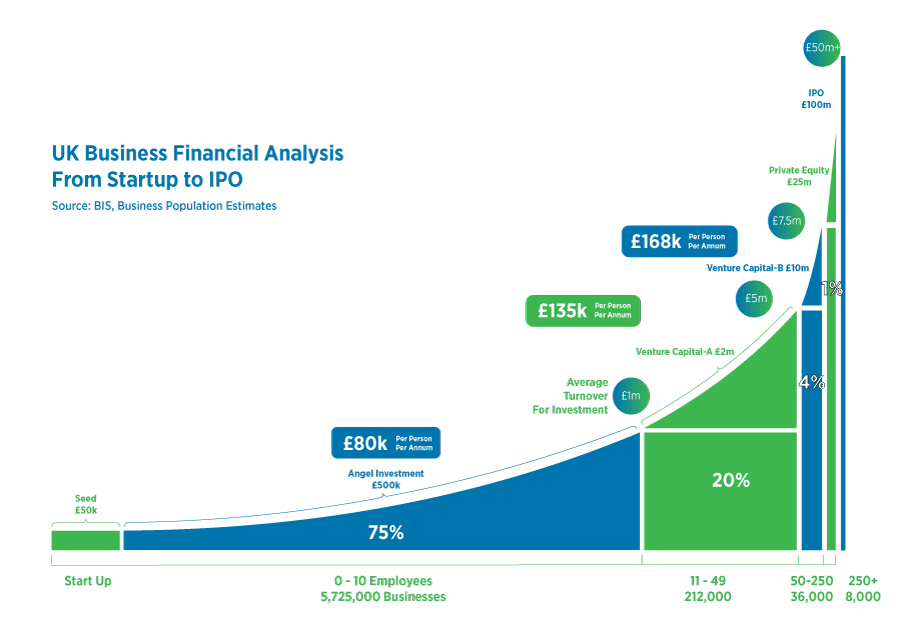
You could take the CVs of 50 CMOs, 50 Marketing Strategies and 50 Marketing Consultants and you’ll see that they’re all the same and have been that way for the past fifty years or so. The primary reason for this is because of their inability to move away from a 1:1 sales process mentality that keeps hampering new business.
Because of the lack of success and growth, you can see why, over the past nearly ten years, the average tenure for CMOs in the UK and USA is only eighteen months? It’s because they promised the earth and failed.
As a CFO you’re not expected to forecast YOY growth, but they do! The trouble is, marketing people promise the earth at the interview stage, they say they can achieve it, and then have no choice but to leave when they don’t.
The most recent CMO employment record I saw on LinkedIn was eighteen jobs and she was CMO at 700-person software business and in her mid to late thirties or perhaps early forties! She had never stayed long enough in one job to ascertain if her plan(s) ever worked.
Now you can see why I said, “Do the figures stack up?”
3. Businesses Forced to Play Nice
As you would expect, business owners listened to their employees and to big tech. They accepted the ROI argument from sales and marketing that marketing automation software was a good idea and it would increase the flow of inbound leads. However, it is called marketing automation, not lead automation! It was also supposed to monitor and provide analytics, and therefore help manage and target the performance of marketing, which, prior to automation was simply an administration role (and still is in my opinion).
As working environments changed, staff began to demand ball-pits, table foosball and free beer on-tap. However, when the marketing processes began failing, the only option left was to find someone new who could make it all work, just as the CEO had been promised in the first place. And to attract this new person, the ball-pits and free-beer was a must.
4. Why Marketing Automation Fails for B2B
The reason marketing automation doesn’t work in B2B settings is because they’re selling products or services intended to increase profitability. That’s it. As I said, marketing and big-tech convinced CEOs to buy in to it, but the evidence was based upon the success of B2C campaigns selling trainers, jeans and cars, all of which the individual buyer can say, “this looks good on me”. However, your typical B2B customer could never say that about SaaS, technology or services or anything else B2B!
Within the sales process, marketing automation simply replaced the physical activity of cold-calling, which was to obtain a compliment slip with the intention of making a telephone cold-call to the prospective customer to gauge any interest.
Marketing automation used by the vendor, attempts to force the prospect into a transaction before defining what it is they’re offering. Asking up-front for an email address and telephone number, makes people shy away, hence according to Gartner 83% of prospects research online before engaging with a salesperson. Or they give their information, get the download, and immediately unsubscribe.
To further support the narrative, a Forrester report a few years ago stated that less than 1% of B2B prospects who traversed the so-called purchasing funnel actually became revenue generating customers.
The additional 'damage' automation does, is that it hides the content from all the search engines. Therefore, if it’s a PDF download, you’re unable to ascertain if the content is any good or if it’s being read. The same as a restricted web page, no one, not even Google, can see it if an email form needs to be completed before accessing it.
However, as Google are the preeminent measure of engaging content, if your web page was to achieve high ranking on their search engine, or even ‘page one’, then it’s the equivalent of getting a gold star. It means the content is well-structured and could very well be engaging to your audience.
But it does not guarantee success, because then, you must hope people are actually searching for your content in the first place.
So, to actually get noticed, you have to factor in the potentially staggering cost of Google pay-per-click, which is supposed to bypass the organic search process and present your banner ad on page one, as long as you have bid more than your competitors.
The final hurdle, is that your whole marketing engagement team need to have first created good enough banner ads, say three, to A/B/C split test the copywriting, to link to a landing page, to hopefully encourage someone to give you their email address and then we’re back to square one. I’ll just stop there for a moment. With this process, you’ve now got: -
- friction on the pay-per-click banner advert, does it work or not?
- friction on the landing page and how it’s laid out, was it ABC split, or multi variate tested?
- friction on engagement because you are demanding a transaction, i.e., asking for their details, before they can access the content
So you can now see why the PPC – B2B – marketing automation process is flawed.
5. A Biased Recruitment Cycle
With all this in mind, the recruitment cycle continues year after year which means you take on someone new, you give them three months to get their feet under the desk, a year to implement the new marketing plan - after they've promised the earth - and as it unfolds that it’s not working or making a difference, they get a further three months to find a new job before they get fired.
And if this didn’t happen at the same 18-month frequency, it was usually because the CEO was forced to get so deeply involved in the marketing that it meant the CMO couldn’t be as readily fired because the CEO was calling the marketing-shots (irrespective of whether he or she was actually qualified or not). Lucky CMO. Also, you won’t see the attributes I talk about in this article on typical marketing related CVs because: -
- the recruitment agencies are not business consultants
- they are filtered out because the recruitment companies simply do their job and send you what you’ve asked for – which is simply a better one than the last one!
- the 18-month churn is great for business, so why change or say anything - hence the full-on biased cycle!
It makes me wonder when I see this constant churn what they say during their interviews; they can’t possibly say they wanted a new challenge!
What exists now is an environment where salespeople have been conditioned into waiting for leads. They rarely engage in telesales as that is the domain of the BDRs and SDRs.
The marketers and salespeople, who have rarely ever run a business are not able to offer entrepreneurial ideas or advice to improve their business units, because the general consensus is that the SMT and CEO are responsible for those ‘types of decisions’.
Naturally, there is an expectation for them to keep their heads down and just get on with what they’re given. Sales and marketing both want things to remain as they are, i.e., they keep getting paid for what they’re doing, or, if the SMT comes up with a new idea, they’re happy to execute it, but it’s not their necks on the line.
6. Consistent Business Failure
Year after year, in the UK, 500,000 businesses start up in the UK and the same number go bust. The statistics below are pitiful: -
- 30% of businesses fail in the first year - FT
- 50% of businesses fail by the second year - FT
- 70% of businesses fail by the third year - FT
- 91% of businesses fail by the 10th year - FT
- 40% of Invested Business Fail - Harvard
- 80% of Invested Business Fail to achieve their own targets - Harvard
- 95% of Invested business Fail to achieve an ROI for Investors - Harvard
- 50% of all business’s failure reasons, are marketing related - CB Insights
- 79% prefer video to phone - Gartner
- 89% believe in sustainable digital GTM - Gartner
- 41% want more video conferencing - McKinsey
- 23% want more online CHAT - McKinsey
- 83% Research Digitally before engaging with a salesman - Gartner
- .5% Less than 1% traverse the 'funnel' and create revenue - Forrester
- 1 in 400 Cold call success rates - University of Life
- £100k turnover per person per annum is the average - BIS
- Average tenure of CMOs in UK & USA is 18 months - Recruitment Industry + Press + Seth Godin
To date, no one seems to know what to do about this constant dilemma. Well, fortunately we do, and I’ll come on to that in a minute.
Before I do, I just want to touch on Digital Transformation. Whilst it is all the rage, and has been for a while, digital transformation is almost entirely focused on business process, and not sales and marketing.
A business wants all the efficiency a business process management platform can offer, like Pega, Appian, Bizagi or ServiceNow, but then one has to factor in the customer. Whilst not an afterthought, customer experience (CX) is paramount to retaining customers.
However, if the route to becoming a customer is fraught with the nonsense you and I have always had to put up with, i.e., typical sales ploys, typical closing techniques and not forgetting account-based marketing (ABM/ABX) that has to involve everyone, then the expectation a business has, for a customer to stay long-term, is that much more difficult, especially if there was no mutual respect in the first place. This translates as a lack of loyalty on behalf of the customer who will switch whenever it suits them, irrespective of clever CX strategies or not.
7. Sales & Marketing Transformation

Here's what the CEO of ServiceNow, Bill McDermott said in a recent Feb 2022 article in ERP Today Magazine: -
- Digital Transformation is the practice of radically disrupting an existing problem or challenge through an entirely different lens. When the world turns on a dime, businesses need to be equipped to execute a new plan in record time. We used to talk about ‘just-in-time’ now we talk about just in case!
- You’ve got to go from linear thinking to exponential thinking. It’s reported that 75% of the Fortune 500 that are on the list today will not be on that list in 2027. Therefore, we have to think of new exponential ways to solve old problems.
- Digital Transformation takes the concept of exponential thinking by radically disrupting convention with a completely fresh approach. Better is not good enough to solve the problems of the 21st century.
- IT architecture is now the business architecture, and the business model will be built upon the IT’s ability to digitally connect with your consumer.
ERP Magazine - ServiceNow - Bill McDermot/
The lack of digital ‘sales & marketing’ transformation is astounding. Everyone wants to be the hero responsible for the widget getting from A to B, but there’s ‘crickets' or 'tumbleweed’ when it comes to sales and marketing.
We’ve now come full circle, back to the ball-pits, free beers, and marketing automation mar-tech stacks, without considering that cameras, mics and lights are digital products too and are necessary components for marketing. However, most marketers have no experience with these types of digital content creation tools and so dismiss them as unnecessary or too expensive and, in my opinion, too complicated and “it’s not my job”.
8. Your Total Addressable Market
There is only one way to break-free from the perpetual low performance that comes about as a result of the 1:1 ratio, and that is to adopt a 'one-to-many' mentality and a corresponding strategy.
It starts with understanding how to first reach your TOTAL addressable market (TAM) on a regular basis. And this means to stop wasting time and money on cold calling and demand generation using marketing automation platforms.
It’s about communicating with a market and knowing the numbers from the outset i.e., knowing that only 1% are looking for your type of product each week, and manoeuvring your business to consistently communicate with them at a relaxed and unobtrusive frequency.
Your business needs the ability to connect with, and engage with, as many prospects as possible, as cost effectively as possible, whether in one country or many. Every potential prospect needs to be assured they can get everything they want from you, 24/7-365 days a year online AND, if they do need to speak to someone, then a highly trained sales professional will be on-hand, on-chat, on-zoom or on-phone, whichever platform the customer is on, in order to get an answer.
As a guide, the total numbers of businesses in the UK are as follows:
- Up to 50 Employees 5.7m
- Up to 249 Employees 212k
- Up to 500 Employees 36k
- Up to 500+ Employees 8k
This type of approach could never be achieved using the current strategies of telesales, BDRs or any other 1:1 ratio of employed infrastructure. Then consider how many businesses 1% would equate to, for the type of product your business sells and how long it would take for your BDRs to reach all your total addressable market.
9. Digital Selling is Not eCommerce
Then there’s the process of educating prospective customers with genuine helpful and meaningful content. This is the essence of a Digital Selling Strategy. It’s the ability to engage with prospects and for them to self-serve; from them having an idea and researching (Re: the Gartner 83%), all the way through to placing an order – with everything being ‘On Demand’, without the need for human-to-human contact.
I am not talking AI, which I believe should stand for artificial interest, or artificial income or artificial intent!
This approach is not uncommon. You only have to look at the success of B2C. BUT you’re not selling trainers, jeans or high energy drinks. I'm also not talking about involving YouTube or Tik-Tok influencers. However, you’re probably selling high value, complex products or services, and your prospects expect you to have a high level of information and content available upon which to evaluate you and place you, on a ‘respect’ scale, before they’ll entertain buying from you.
Done properly, the transition to digital selling may entail the redeployment of certain staff. However, a shift occurs in the finances of the business as less telesales people are required to find prospects, less people are required to close the sales and as a result less commission is payable because more income is derived from self-service.
Furthermore, the digital asset visibility increases month-on-month as those assets are no longer being hidden behind an email form to support the marketing automation platform. And, as your visibility increases with the search engines, expenditure is drastically reduced and the effectiveness of marketing is significantly enhanced.
The gearing ratio from selling changes from 1:1 to 1: many, which means there is no limit to the number of businesses who could investigate your products and learn how to implement them.
Reaching your total addressable market and communicating with them every week, could be achieved by one properly trained person, making a whole telesales team redundant!
10. How do We Know this?
In the past I started up technology businesses and I personally sold millions of pounds worth of telecoms technology and integrated CRM SaaS. So I know the issues everyone has, from running a business in the first place, to telesales to field sales to installation and implementation and training and so on.
To nutshell this:
- The business must be clear who and where their market is
- They must easily and cost effectively tell their market their business exists
- Prospects must have the ability to self-serve all the way to placing an order
- They must provide every means available to facilitate contact (phone, video, chat, email and live)
The above might seem obvious, but as soon as telesales is adopted, a 1:1 ratio is established and the above cannot be achieved and you’re back to square-one.
The important thing here is for you to quickly pick-up what we’re recommending and to see how this can be implemented in your businesses with the minimum fuss, for the least cost and maximum benefit.
From a purely financial perspective, you would be asked "does this approach to change make financial sense" and "does it make sense for new business generation?" It’s also a pivotal point too because, as CFO, you're in the unenviable position of making a decision whether to mention this to your colleagues or not.
11. How to Get Started
The process of transitioning to Digital Selling begins with changing perspective on the whole engagement process. It’s not about prospecting, cold calling or closing. It’s about aligning your business to the way in which we all approach acquiring products we like or need.
When it comes to Digital Selling, your business can implement this immediately. However, we would recommend you look at what your existing teams have been doing over the past few years to see how closely they are aligned to what I’m saying; it may help initially if we provide some direction to help with the process.
But I will point out, our web site is set up for digital selling, so we’ve made everything freely available, and so there’s no access codes or emails or logins. But we can talk about how we can help another time.
12. The Transition from Old to New
Let's start with the most obvious question. How long will it take? It depends on the existing content your marketing has used and what can be updated and adapted. I would recommend setting up the digital selling strategy in parallel with your current strategy. Therefore as the new strategy gathers momentum, the old process will decrease.
As a stab in the dark, I would say, it shouldn’t take longer than between four to six months to get the foundation created and operational. That’s why it’s best to talk about this first with a specialist.
13. Content Restructure
I do not want to dismiss any of the operational matters simply because you are finance orientated, so I have provided a comprehensive illustration and explanation about execution.
Whilst persona and segmentation have been the buzzwords for a few years in marketing, existing content is to be reorganised into Primary, Secondary, General, Product and How to Buy as this is how people review content and buy products or services, we all do!

Once they’re on your website, they might look at the About Us page (General), then click on a case study (Secondary), then on a ‘How to’ video (Product) and to finish they might want to find out how much you charge and what’s involved in the buying process (How to Buy). We all bounce all over the place and certainly don't follow some pre-conceived idea that we're moving down a funnel, ending up as a customer.
As you can see from the list below, it doesn’t matter who is looking at your business as long as you’re able to satisfy their questions and query process:
General
- Blogs, New Hires
- CSR, Awards, PR
- Guest Activities
Secondary Content
- Social Proof
- Case Studies
- Infographics
- Podcast/Video/Live
Primary Content
- Thought Leadership
- Business Case
- Whitepapers
- Pro' Publications
Product Content
- How it works
- How to install it
- Best Practices
- Training
- FAQs
How to Buy
There is also a set of references that relate to what’s called the Moment of Truth, which are directly related to the so-called funnel and also the activities or stages I’ve mentioned above.
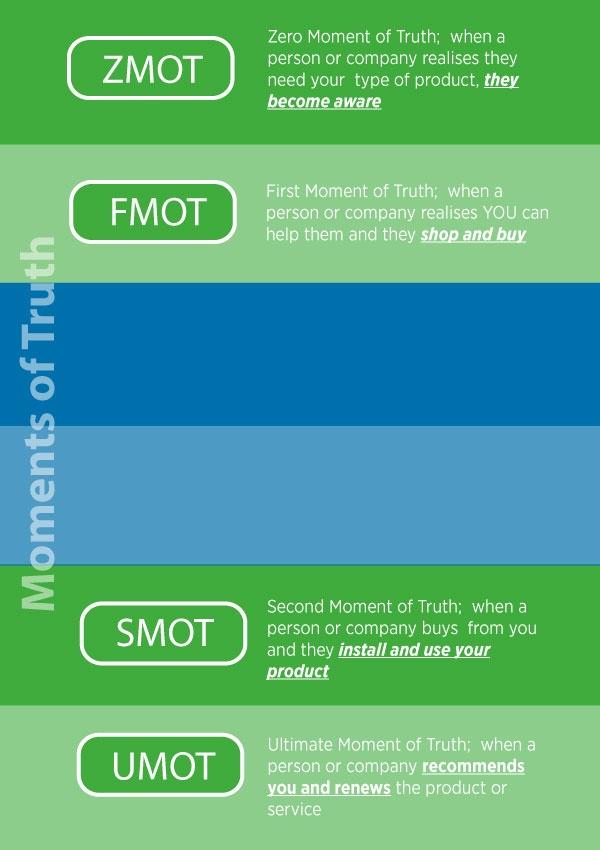
Multiple types of content are to be provided as no one can second guess or make a decision as to what type of content another person prefers or when they prefer it. The content will include videos, podcasts, live streaming, articles, downloads and infographics.
SEO, Google Tag Manager, Google Analytics can be reviewed as per our strategies and documentation to ensure constant visibility, ongoing content penetration and management.
It can be difficult to visualise the extent of what is required. Below is an image of the content modelling spreadsheet we use to ensure we keep track of what content has been created, for which stage, and where its corresponding advert is being displayed.

To ensure you have complete visibility on what we’re suggesting, below are links to our web pages that explain and demonstrate our expertise relating to the activities. Naturally you can cross-check with your own team to verify our ‘abilities’. I say this because there are so many so-called experts who are skilful at misleading businesses. To address this, we have explained everything in advance:
14. Content Promotion
Selling is a numbers game! However, if you’re not able to manage the numbers, it will be a struggle to sell anything. 1% of your total addressable market are looking to buy your type of product every week. I know you can do the maths. If sales believe the ideal vertical is 20,000 businesses in the UK, then 200 people each week are looking!
Here is the approach to address your whole market: -
- If you don’t already have it, buy a database of your ideal vertical market.
- Upload the data to your CRM
- Upload the data to LinkedIn & Facebook
- Set up a PPC campaign to inform your market you have a live stream show (limit your PPC against your budget)
- Email your market to tell them what happened on last week’s show and what’s coming up this week
- Repeat every week
No marketing automation platform is required for this! For £100 per month, you can send out 10,000 emails up to 12 times a month, so we're talking pennies by comparison.
Another critical aspect of Digital Selling is to make a point of promoting and ‘selling’ the content, not the product. Your prospects know you sell the product, but what they need is to be educated as to how best implement your product or get the most out of it. This is why much of the content created will be educational and promoted on social media.
We have a documented strategy called Social 444, which involves posting 4 adverts, four times a day for four weeks and then repeat.
As you’re selling to a business market, they will only see your post if they’re logged in and are scrolling down their newsfeed on LinkedIn. That’s why we recommend you create 120 adverts in advance, that include graphics, motion graphics, memes and videos and rotate them every month. It would be highly unlikely anyone could come across the same advert twice and, because it’s a social media post and not a banner advert and it’s rotated every month, again, it costs pennies.
A bit of insight to new business 'buyer's' behaviour; it takes 7-10 direct connections before a prospect recognises your brand/company; however, 1-in-3 attempts to contact a prospect fails. Therefore, you need 30+ messages lined up to achieve engagement and sending out no more than one message per week. This means you have to allow six or seven months to start reaping any rewards. This is another fundamental reason why so many businesses fail – they don’t have the patience and think they can achieve success by employing the most basic tactic in terms of technical execution, management, and cost, i.e., cold calling.
The recommended content promotion strategy means you can virtually use the term ‘set-and-forget’ as the adverts and available content do not need to be changed for up to 12-18 months. Now can you see why the current business structure for marketing is out of sync with actual requirements of business buyers?
15. Financial Factors & Implications
For a New Business: Create all necessary content in advance. Grow the ‘attraction’ strategy before embarking on a fund-raising exercise and gifting a large portion of your business to investors before you have properly tested the market. It may surprise you that you need far less investment than anticipated
For an Existing Business: Implement a digital selling strategy in parallel to the existing marketing plan and ascertain who in sales can support the content development teams. Implement the process to reach out to the total addressable market and gauge what elements need to be put in place.
For Mergers & Acquisitions: Prior to agreeing to a merger, implement a fact-finding task force to reassess the market potential, based upon the Digital Selling Strategy. If purchasing a new business, re-evaluate your forecasts against their current success rates and recalculate.
16. How Much Will It Cost?
If you have a marketing or content team in place then to begin with, they need to start addressing the existing content and preparing new videos, podcasts and so on.
If you already have a database, great, if not, then begin with identifying your total addressable market and acquire a new database which will cost approximately £350 per 1000 names (one off cost). For example, a one-off cost would be £3,500 if you have a total addressable market of 10k companies
Monthly SaaS costs would be in the region of £300-£400 per month:
Email - £150
Auto Posting on social media - £60
Live Stream Software in-house - £50
Multi Streaming Platform - £50
When it comes to video and live streaming, you want to acquire the most cost effective and useful equipment possible. We can give you a shopping list, but I’m sure you know this would need a conversation. However, we would suggest a budget of between £40k to £60k which would include multiple cameras, switchers, lights, tripods, stands and so on.
In very broad terms, say £40k for the first year and £4k for the second and third.
If you needed an advisor (e.g., salesXchange) to get things set up and train existing staff, allow £10-15k
Two people could manage the whole operation and reach out to your total addressable market every week. Now compare this to the current total cost of telesales, SaaS and marketing attributed to generating new business.
There is the other aspect of this too; and that’s about using the equipment to record and create all the other digital content required, from how-to videos to video recorded podcasts. This list is endless and there’s no shortage of people willing to binge-watch if it’s about something they’re interested in.
As you know, the hardware is a fixed asset, amortised and written off over three years. The monthly costs are tiny; the staff costs to execute this are minimal.
Considering the existing costs and work effort that goes into cold calling by BDRs, coupled with the staggeringly low success rates, nothing can compare to the exposure this strategy delivers. Even if it cost £100k as a one-off cost, it would be cheaper and more profitable than anything you’re current doing.
The important factor here is to demonstrate we have prepared everything in advance, and broken down every cost to its component part, to help provide a comprehensive and robust cost illustration with supporting, explanatory information. Below is an illustration of our modelling spreadsheet that helps us calculate every cost associated with digital selling.

17. Project Execution Infographic
I have created two mirrored illustrations to show what the business needs to do, and how the retention process would affect customers. Every business needs to visualise the complete journey from start to finish. The infographics below will help.


Click here to view The Customer Retention Infographic.
18. Digital Selling Organisational Chart
As you can see from the first diagram below, I have defined the three main business units relating to new business as Technology, Revenue and Content (formerly IT, Sales and Marketing) and within each business unit, I have moved certain skill sets around. I have placed the Chief Growth Officer with overall responsibility for this section of the business.
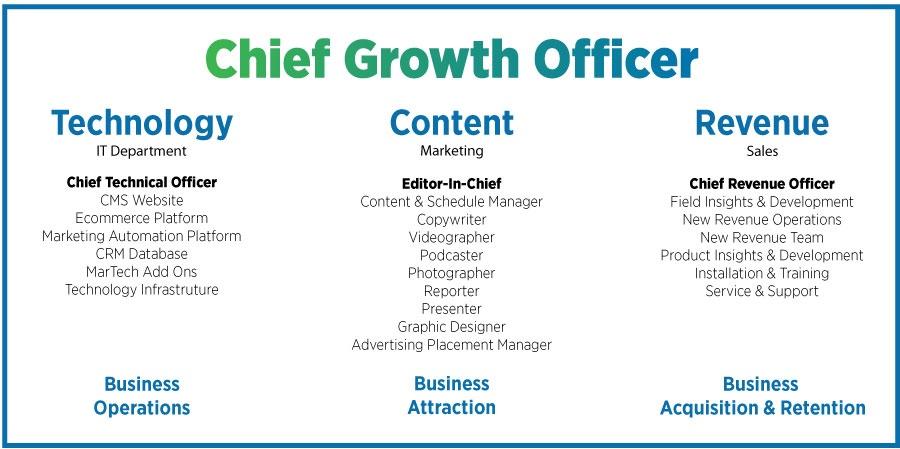
I have produced a completed organisational chart to show how digital selling plays out – it’s interesting reading as it also makes sense of the role the Chief Revenue Officer plays in conjunction with the Chief Growth Officer. Download the excel spreadsheet (The New Revenue Org Chart - available here) as it includes a variety of descriptions and explanations to help you visualise this approach.
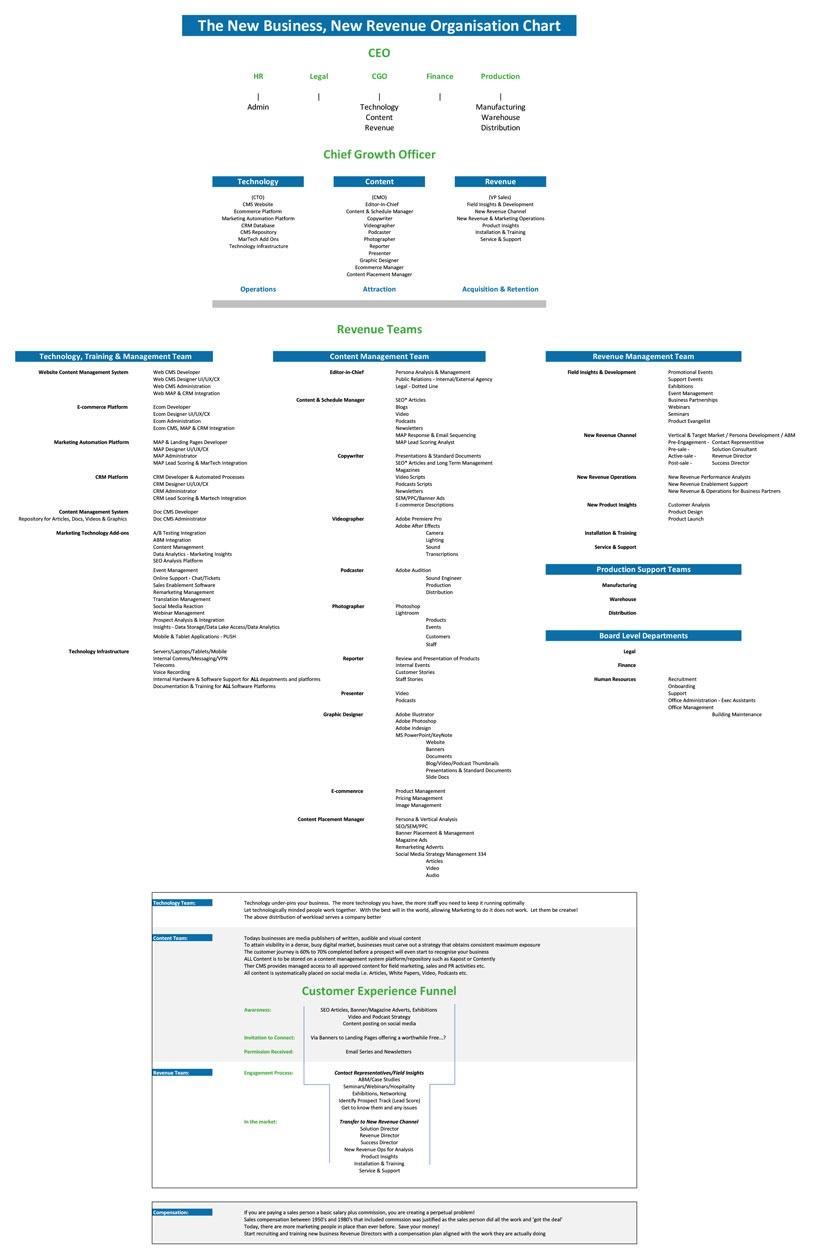
The Technology Team
It is important that there is continuity in technical support for the wide variety of software needed these days. When creative people are expected to fully understand how the software works and are able to devise marketing strategies, including the copywriting and so on, if that person leaves the company, more expertise is lost than simply the marketing ability to write copy.
The Technology Team are responsible for the management and implementation of ALL hardware and software. I know there are marketing platforms that say “use our kit without disturbing the IT department” but that does not work as there are not sufficient demarcation points. That said, I also believe that all web development, CMS, ecommerce and marketing automation should also reside there as well as User and Customer Experience teams.
Keeping the technical aspect within the Technology department means there is a constant resource available with ‘crossover’ training available if necessary. This ensures that Technology is the engine for the business.
But before some bright spark in the IT department thinks he or she is going to be controlling the business, think again. The technology department can now be seen as a cost centre as all the rest. If anyone starts getting all high and mighty the Chief Growth Officer should have the autonomy to fire them!
The Revenue Team
Transition is a breeze – rename the existing sales team the “A Team” and create another called the “New Team”. The A Team will seek and find new business; do all the work necessary to close sales and be paid accordingly, as they are not going to be a drain on the marketing budget or mechanism.
- A Team – Commission Based Targeted Salespeople
- New Team - Revenue Directors - Group Based Bonuses
The Field Insights Management team will help drive new enquiries to the New Revenue Channels’ Pre-engagement representatives. Once the pre-engagement representative has completed the ‘data-fill’, the Field Insights Team, together with the various support teams, will accompany the prospect on their journey through the company process until the prospect is ready to buy.
When the prospect is ready to buy, The New Team A.k.a. New Revenue Director arranges the necessary demonstrations, proposals, analysis and data-fill and asks for the order.
Once complete/signed up, the sale is handed over and managed by Installation/Training or whatever implementation process you have, and in turn, handed over to Customer Success.
The Content Team
Our suggestion is to rename ‘Marketing’ to ‘Content’ and drive this element of your business as if it were a publishing house. Work along the lines of having reporters, researchers and presenters, enabling your business to fully embrace written content, i.e., articles, videos and podcasts.
The objective is to start creating an interconnected framework of information, blogs, guides, links to supporting content, and exposure - written, audible and visual; content that accurately positions you and your business where your prospects are actually looking, marrying up with ‘search intent’. You must be viewed as an authority in your space by creating detailed and explanatory content that helps people understand your products and how to use them. This will elevate you above your competition who are still dialling for dollars or phoning for pennies!
The Content Team will seek and find new business. They will create content that communicates to your desired vertical market(s) and persona(s), but more importantly create content that aligns with Primary, Secondary, General, Product and How to Buy.
They will create a process that elevates the company, makes it visible in its desired geographic area and they will draw in and attract new business via a combination of activities with the combined support with the Field Insight Team.
19. An Insight to Scalable Digital Selling
Initially I believed businesses needed to create cinematic type, high quality video as per the content creators on YouTube. So, rather than just spout to business what I thought, I invested close to £50k in cameras, lighting, audio and all the necessary equipment and began learning from the ground up. It included editing, production and learning and watching as much as I could get my hands on.
Over the next few years, including the lockdown, I gradually realised what was actually needed was a total restructure of the B2B organisation, because it simply wasn’t working and because I had joined up the dots where no one else had.
As a result, I developed my vision, or version of, digital selling. It addresses the whole cold calling issue, through to the problem with automation (it doesn't work), and naturally aligning everything to the behaviour of people, like you and I, and the way in which we like to buy business related products compared to personal consumer products.
To explain how I work, I run everything on a MacBook Pro. I use a Rodecaster Pro for Podcasts, multiple Panasonic DSLR cameras for photos and video and a variety of one-touch buttons and switching gear when I'm live streaming. Finally, I have a variety of different LED lights, from Aputure 120D daylight lights to mini-LEDs that are using as background effect lights.
For live streaming I use software from Ecamm, which is pretty clever by itself, but using another add-on I can stream to multiple platforms all at the same time, that means LinkedIn, Facebook and YouTube and record the show locally AND I don’t need to do any editing, which is something else worth knowing.
At the end of the day, anyone can have a streaming set up either at a home office or some space allocated at a central office or both. Bearing in mind, with so many people working from home, more space might be available that can be used as a studio. Live Streaming is the only way to reach your total addressable market on a regular basis, at the least cost, with the minimum of staff with the maximum impact and alignment to the expectations of your prospects.
Conclusion
As you can see from the above, the overall strategy is straightforward, financially viable, with no chance of overspending. It requires minimum management and lends itself towards maximum exposure to the correct market and keeps every element of new business expenditure in check.
It is monitored via Google Tag Manager and Google Analytics from a visibility and engagement perspective, made even simpler by using Google Data Studio (GDS). GDS sends everyone statistics on progress from content that is being read, to the duration of engagement, even how long they watch the videos for.
Recruitment to increase sales or marketing personnel is only necessary if any given area is increasing performance and requires more support.
The new organisational structure has a calming effect on attrition and helps reduce ‘technical talent’ walking out the door as it is intrinsically linked to IT and not marketing.
I hope you are impressed, surprised or relieved - I’m not sure which should be the right description. Whichever it is, I hope once you’ve had time to think about this you will be keen to share it with your colleagues and for them to have an opportunity to explore a possible new strategy for the future success and stability of your business.
Many thanks for listening/reading to the end and I hope we will meet at some stage in the near future, possibly at a board meeting.
For a detailed illustration of a Sales & Marketing Operating System, take a look at the overview for a Digital Selling Strategy for SaaS Subscription Business Model
This is the link page I’d like to suggest your CEO reads or watches - https://salesxchange.co.uk/resources/videos/item/digital-business-plan-for-ceo .

The author and founder of salesXchange, Nigel Maine is a B2B marketing and sales expert with a proven track record in scaling up growth for Technology, SaaS, and Professional Services organisations. With 30 years hands-on experience and unique approach, Nigel has developed an effective strategy that dramatically increases exposure and profitability for B2B organizations.


